OVERVIEW
What working with PP actually involves.
Polypropylene is the most widely injection-moulded resin in the world, mostly because it is cheap, light and chemically inert. It is also semi-crystalline, which is why it behaves differently from ABS: it shrinks more, it crystallises slowly, and it wants more draft than you would expect.
| Property | What it means for your tool |
|---|---|
| Shrinkage | About 1.0-2.5% – the highest of the commodity resins; the cavity has to be generous |
| Behaviour | Semi-crystalline: slow set, so cooling time dominates the cycle |
| Strength | Good fatigue and snap-fit behaviour; flexes instead of cracking |
| Chemical / water | Excellent chemical resistance, near-zero water absorption |
| Watch out | Warpage on flat parts, shrinkage voids, and very low shrinkage in the flow direction |
| Typical grades | Homopolymer, copolymer (impact), random copolymer, talc-filled, glass-filled |
Draft and wall
PP is semi-crystalline and shrinks noticeably, so every wall needs real draft – a 1-1.5 degree minimum, more on textured surfaces. Thin walls also reduce the shrinkage that causes warpage, which is why we push customers towards a lighter, stiffer section instead of a heavy one.
Cooling
Because the resin crystallises as it cools, the part keeps shrinking after it leaves the cavity. We lengthen the cooling circuit and the cycle to hold the dimension, rather than cutting the cavity to chase a moving target.
Glass-filled PP
GF-PP is stiff, dimensionally stable and dimensionally repeatable – but it is very hard on the tool. It needs harder cores and a wear-resistant cavity, and it will cut through a soft P20 cavity long before the customer is happy with the part.
Typical parts we run in this material
- Packaging: caps, closures, thin-walled containers
- Automotive: bumpers, under-bonnet reservoirs, wheel-arch liners
- Household: storage boxes, buckets, planters
- Appliance: brackets, tubs and liners
- Garden and irrigation: fittings, sprayer bodies, hose connectors
Where it gets difficult
- Flat panels warp. If your part is a lid, a tray or a panel, tell us the tolerance you need to hold and we will design the ribs and cooling to hold it, or tell you honestly that a different material will hold it better.
- Snap fits and living hinges need a slightly higher melt flow grade than the general-purpose one – we specify the grade, not just the resin family.
- Do not mix PP grades between the first and production runs. The shrinkage difference shows up as a batch-to-batch dimension drift.
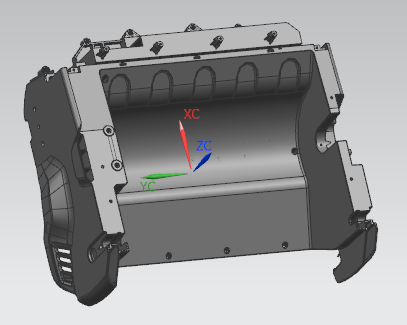 CAD VISUALIZATION
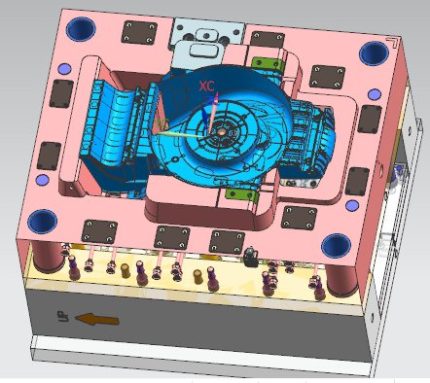 CAD VISUALIZATION
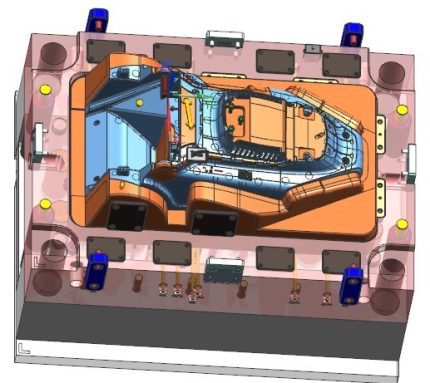 CAD VISUALIZATION
Mold-flow studies we run before steel is cut, on the real part geometry.
Send us the drawing.
We will come back with material grade, cavity count, tool steel and a dated T1 schedule.