OVERVIEW
What working with PC actually involves.
Polycarbonate is transparent, impact-resistant, and holds its properties across a wide temperature range, which is why it is the default for medical fluid components, electrical housings and optical parts. It is amorphous, so it shrinks little and machines well. It is also hygroscopic and susceptible to stress cracking, and it needs a hotter tool than most people expect.
| Property | What it means for your tool |
|---|---|
| Shrinkage | About 0.5-0.7% – low, with good dimensional repeatability |
| Behaviour | Amorphous, transparent, high impact strength |
| Temperature | High heat deflection temperature, but not a high-temperature resin |
| Moisture | Hygroscopic – must be dried before moulding |
| Watch out | Stress cracking from cold assembly, over-moulding inserts, or incompatible metal contact |
| Typical grades | General purpose, medical, optical, flame-retardant (PC/ABS blends) |
| Cost | Roughly $3-4/kg – several times the price of PP |
Drying is not optional
PC picks up moisture from the air, and wet PC gives streaks, bubbles and reduced impact strength. We dry on the machine before every run and log it, because the difference between a good batch and a rejected one is often hours of drying, not a different tool.
Hot tool, slower cycle
PC needs a hotter mould than ABS or PP to get a good crystallisation-free surface. We heat the tool to 80-100 degrees and accept the longer cycle, because cold mold gives poor appearance and higher residual stress.
Stress cracking is a design issue
PC parts fail in service not because the tool was wrong but because the assembly put stress into the part – an interference fit, a metal insert with a sharp edge, a snap fit. We review the assembly at DFM stage and tell you where the stress will land.
Typical parts we run in this material
- Medical fluid components: stopcocks, blood-drip chambers, catheter hubs
- Laboratory consumables: sample vials, tube racks, pipette bodies
- Electrical and electronics housings, insulation parts
- Connectors, terminal blocks, sensor bodies
- Lighting reflectors, diffusers, optical housings
Where it gets difficult
- Never put a PC part in a snap fit that is assembled in the cold, or tighten a metal screw straight into it. The part will look fine on the bench and crack in the customer’s car.
- PC/ABS is usually the better answer for a housing that needs flame retardancy and impact – we will tell you when PC is overkill.
- Medical grades need a specific compliance route. Tell us the target market and we will tell you which documents you can actually get for the part.
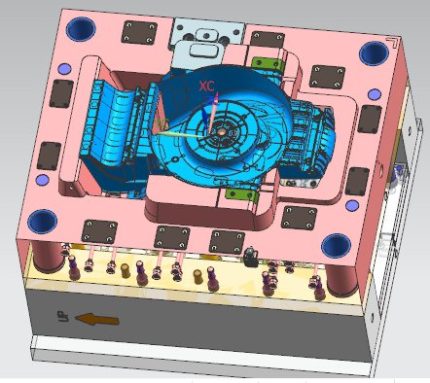 CAD VISUALIZATION
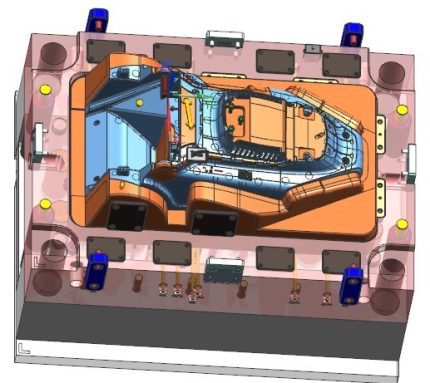 CAD VISUALIZATION
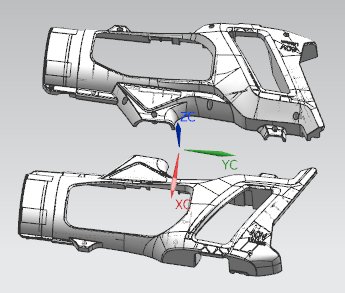 CAD VISUALIZATION
Mold-flow studies we run before steel is cut, on the real part geometry.
Send us the drawing.
We will come back with material grade, cavity count, tool steel and a dated T1 schedule.