OVERVIEW
What working with POM / PMMA actually involves.
POM (acetal) and PMMA (acrylic) are the two resins a precision buyer reaches for when the part has to be dimensionally exact or optically clear. POM is a semi-crystalline engineering polymer with very low friction and very low shrinkage. PMMA is amorphous, transparent and polished – and it shows every flow line, gate and scratch on the part.
| Property | What it means for your tool |
|---|---|
| POM shrinkage | About 0.2-0.5% – very low, so POM parts hold tolerance unusually well |
| POM behaviour | Semi-crystalline, stiff, low friction, excellent wear and dimensional stability |
| POM watch out | Fumes on machining are unpleasant; POM is not a UV resin and it is not UV-stable |
| PMMA shrinkage | About 0.3-0.6%, low, but it is brittle and it shrinks isotropically |
| PMMA behaviour | Amorphous, transparent to the edge, superb polish, hard but brittle |
| PMMA watch out | Every flow line, gate and inclusion is visible; it is a cosmetic material |
| Typical grades | POM natural, POM-C, POM+PTFE, PMMA general, PMMA optical, PMMA UV-stabilised |
POM for precision, and it will not forgive a bad gate
POM’s low shrinkage lets you hold a tight tolerance, but its crystallisation means the part keeps moving for a few days after moulding. We dimension for the conditioned state and tell you the conditioning schedule so your incoming inspection matches ours.
PMMA is a cosmetic material – the tool decides the look
Clear parts show everything. To get a good PMMA surface the tool needs full polish, no ejector marks, balanced gating and clean parting. We design the parting line and the gate position around the face the customer sees, and we polish the cavity to the finish you specify.
Both need honest cooling
PMMA cools fast but crazes if it is cooled unevenly under stress; POM needs enough cooling to reach full crystallisation. The cooling circuit is designed per resin, not copied between tools.
Typical parts we run in this material
- POM: gears, cams, bushings, hinges, snap fits, precision spacers
- PMMA: lenses, light guides, display covers, knobs, transparent housings
- POM: medical dosing components, food-metering parts
- PMMA: signage, museum display, lighting, aquarium components
- Both: model and prototype parts where fit and finish matter
Where it gets difficult
- POM is not for UV or outdoor use – it will chalk and crack. If the part is outdoors, we will say so and propose a different resin.
- PMMA is brittle: a sharp thread or an interference fit will crack it. We will tell you where the stress is before you build the assembly around it.
- If a part is both precise and clear, check the resin first – usually one of them is the wrong requirement.
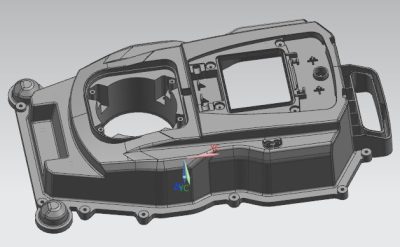 CAD VISUALIZATION
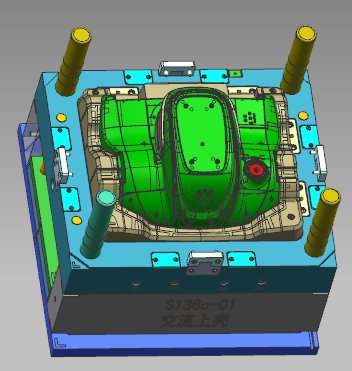 CAD VISUALIZATION
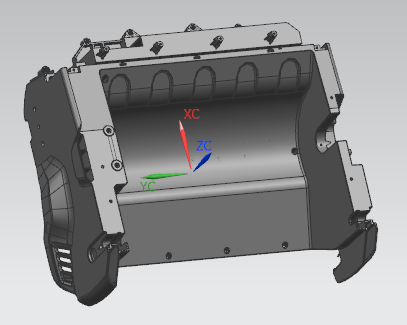 CAD VISUALIZATION
Mold-flow studies we run before steel is cut, on the real part geometry.
Send us the drawing.
We will come back with material grade, cavity count, tool steel and a dated T1 schedule.