OVERVIEW
What working with ABS actually involves.
ABS is amorphous, which is the single most useful fact about it. It shrinks predictably (about 0.4-0.8%), holds a surface finish, survives impact, and costs less than PC while doing a lot of what PC does. It is also the resin that most automotive interior trim, appliance housings and consumer-electronics shells are made from.
| Property | What it means for your tool |
|---|---|
| Shrinkage | About 0.4-0.8% – low and repeatable, so tight tolerances are achievable |
| Behaviour | Amorphous: no sharp crystallisation, good dimensional stability |
| Impact / stiffness | Good impact strength, rigid enough for housings and trim |
| Surface finish | Takes a good polished or textured finish straight from the tool |
| Watch out | Sink marks in thick sections; needs a balanced gate and even cooling |
| Typical grades | General purpose, flame-retardant, high-gloss, textured |
Cavity design
Because ABS shrinks little, the cavity can be cut close to nominal. The real problem is not shrinkage but sink: ABS is easy to fill and will pull the surface in on ribs and bosses. We balance the wall, the rib thickness and the cooling so the cosmetic face stays flat.
Tool steel
P20 is enough for short-to-medium runs in ABS. For high-volume or long-life ABS tools we move to hardened cores so the polished cavity keeps its finish and the tool can run into the hundreds of thousands of shots without losing gloss.
Cooling and cycle
ABS flows readily, so cycle times are short – typically 20-40 seconds on a multi-cavity tool depending on wall thickness. The bottleneck is usually cooling on thick sections, not the fill.
Typical parts we run in this material
- Automotive interior trim, wheel-arch liners, instrument-panel bezels
- Appliance housings, control-panel shells, washing-machine parts
- Consumer electronics enclosures, remote-control bodies, docking stations
- Cable-tie ends, clips and covers
- Toys and hobby parts, cosmetic lids and caps
Where it gets difficult
- Thick sections sink even when the tool is correct – if you have an end-of-fill or cosmetic issue, send us the 3D file and we will tell you whether it is geometry, gating or cooling.
- ABS is hygroscopic enough that drying matters; resin that has been left open overnight will change the viscosity and the appearance.
- Never specify a general-purpose grade when the part is under heat or near a flame – flame-retardant grades are a different moulding problem, not a drop-in substitute.
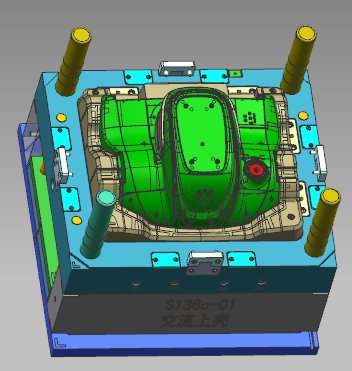 CAD VISUALIZATION
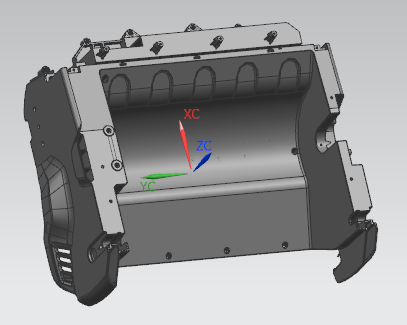 CAD VISUALIZATION
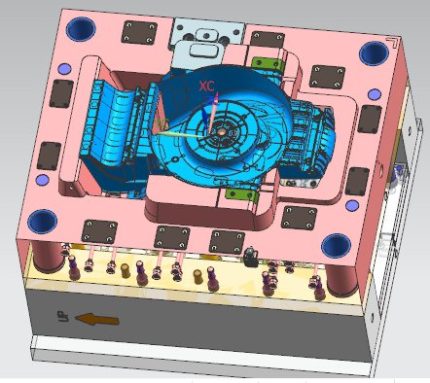 CAD VISUALIZATION
Mold-flow studies we run before steel is cut, on the real part geometry.
Send us the drawing.
We will come back with material grade, cavity count, tool steel and a dated T1 schedule.