Sanitary Tooling · Precision Plastic Injection Molding
One-Piece ABS Plastic Faucet Injection Molding: Advanced Tooling Design, Hydraulic Core Pulling & Direct Electroplating
As a premier plastic injection molding manufacturer, Ningbo Hengxin Mold Co., Ltd. (HX Mould) delivers turnkey custom plastic injection molding solutions for sanitaryware and plumbing fixtures. This technical guide explores how advanced plastic injection mold design, synchronized multi-axis hydraulic core pulling, and mirror-finished Assab S136 ESR steel enable seamless one-piece ABS faucet bodies with 0.01 – 0.03 mm parting line mismatch, eliminating manual polishing prior to high-adhesion chrome electroplating.
1. The Manufacturing Evolution: Cast Brass vs. Custom Plastic Injection Molding
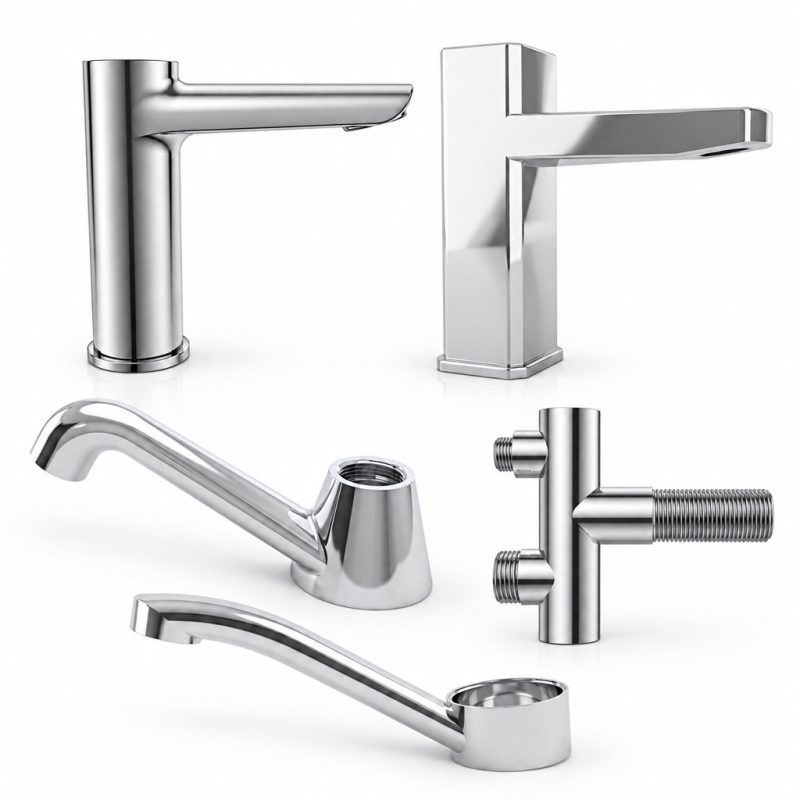
Global sanitary brands are rapidly replacing heavy brass sand castings with precision ABS plastic injection molding. Beyond achieving 100% lead-free compliance, one-piece custom injection molding streamlines production by replacing secondary machining, welding, and buffing operations with automated single-shot molding:
| Performance Metric | Traditional Cast Brass Faucet | Glued / Welded Multi-Piece Plastic | HX Mould Precision One-Piece ABS Faucet |
|---|---|---|---|
| Lead Leaching & Toxicity | Heavy metal risk (requires internal washing) | 100% Lead-Free | 100% Lead-Free & NSF/ANSI 61 Compliant |
| Burst Pressure & Leak Risk | High strength, potential casting porosity | Ultrasonic weld seam failure (< 1.5 MPa) | Seamless Waterway: Burst Pressure > 3.0 – 3.5 MPa (35 bar) |
| Part Weight & Logistics Cost | 800 – 1,500 g | 250 – 350 g | 220 – 320 g (Up to 70% freight weight savings) |
| Scale & Corrosion Resistance | Dezincification, limescale deposition | Corrosion resistant | Ultra-smooth internal bore (Zero calcification/scale) |
| Production Cycle Time | Multi-step casting, trimming & CNC machining | Multiple molding shots + ultrasonic assembly | Single-shot injection molding services (45–60s cycle) |
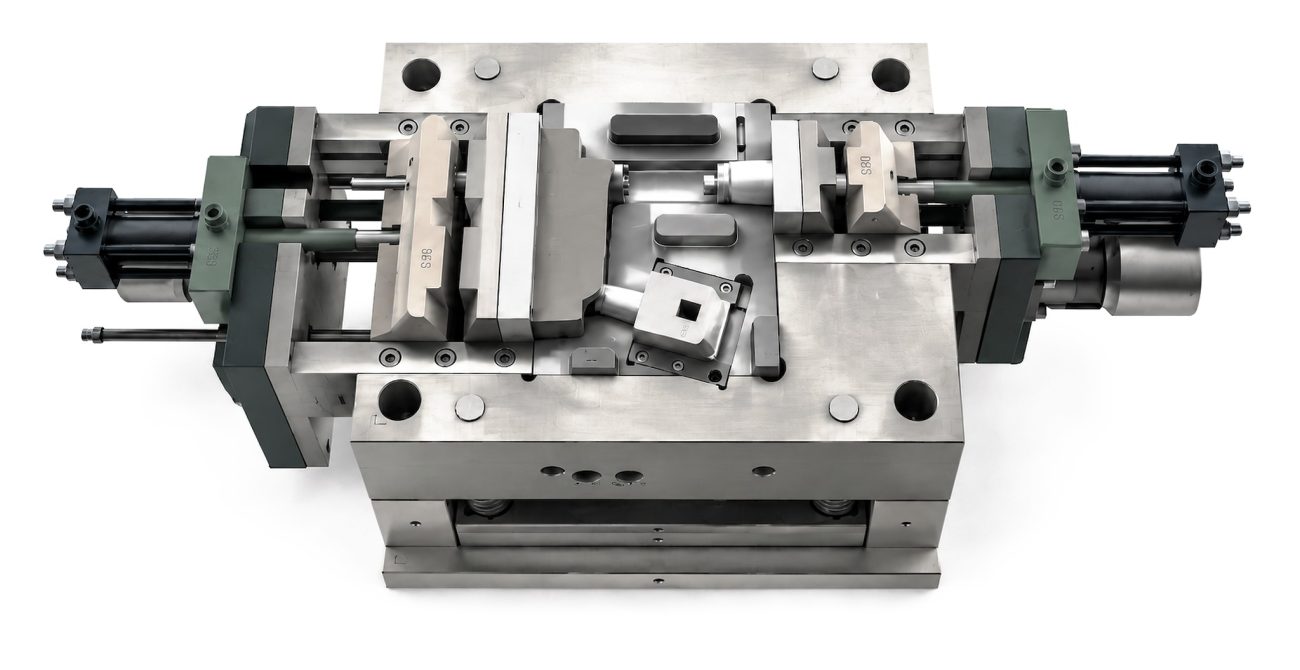
2. Advanced Plastic Injection Mold Design: Hydraulic Core-Pulling & DFM
In complex sanitaryware tooling, thorough DFM injection molding analysis is crucial. Forming intersecting hot and cold water conduits, ceramic cartridge chambers, and spout aerator threads within a single rigid mold demands specialized tooling architecture:
- Synchronized Multi-Directional Hydraulic Slides: Opposing long-stroke hydraulic cylinders actuate internal core pins at compound angles, interlocking inside the valve chamber with an alignment tolerance within ±0.008 mm.
- Moldflow Gate & Cooling Optimization: Employing sequential valve hot runner gates eliminates visible weld lines (knit lines) on front-facing cosmetic surfaces, ensuring uniform material density throughout the pressurized body.
- Zero-Draft Slide Sealing Mechanisms: Precision step-locks seal core-to-core shut-off faces under 120T–250T clamping force, completely preventing internal flash that could impede water flow or cartridge assembly.
3. Tooling Steel & Direct-to-Electroplating Technology
In high-end sanitary hardware, manual post-mold buffing distorts sharp parting lines and causes inconsistent wall thickness. At HX Mould, our precision plastic injection molding tooling is engineered for direct electroplating:
A. Assab S136 ESR Tool Steel (HRC 50 – 54)
We build cavity and core inserts using vacuum-hardened Assab S136 ESR (Electro-Slag Remelted) stainless steel. ESR processing guarantees an inclusion-free microstructure, achieving an optical mirror polish of SPI A1+ (Ra < 0.012 μm).
B. Parting Line Mismatch Controlled within 0.01 – 0.03 mm
High-speed 5-axis CNC contour milling and mirror wire EDM hold mold split lines to sub-micron accuracy. Molded ABS faucet bodies exit the mold with near-zero witness lines, allowing parts to transfer directly to the plating line without manual sanding.
C. Plating-Grade ABS Resin & Metal Adhesion Strength
We specify specialized electroplating-grade ABS (e.g. Chi Mei PA-727, LG ER400) featuring uniformly dispersed polybutadiene rubber spheres (0.2 – 0.4 μm). Chemical conditioning etches micro-anchor pits into the SAN matrix, delivering exceptional multi-layer plating adhesion:
- Ductile Copper Layer (15 – 20 μm): Equalizes thermal expansion differences between polymer and metal.
- Semi-Bright + Bright Nickel (10 – 15 μm): Delivers comprehensive micro-porous corrosion barrier protection.
- Mirror Chrome Finish (0.25 – 0.5 μm): Provides high surface hardness, scratch resistance, and brilliant luster.
- Thermal Cycling Rigor (ASTM B553): Tested through 4 consecutive cycles of 80°C (1 hour) → −40°C (1 hour) with zero blistering, flaking, or delamination.
4. Injection Molding Process Parameters for Stress-Free Sanitary Components
| Process Parameter | Target Specification | Engineering Objective & Defect Prevention |
|---|---|---|
| Melt Temperature | 230°C – 250°C | Maintains optimal resin fluidity while preventing thermal breakdown of rubber phase |
| Mold Temperature | 65°C – 80°C (Pressurized Water) | Minimizes internal residual stress; prevents micro-cracking during chromic acid etching |
| Injection Velocity Profile | Slow (gate) → Fast (cavity) → Slow (cushion) | Eliminates jetting marks, gate blush, and air entrapment around long slide pins |
| Packing Pressure & Time | 65 – 85 MPa (8 – 12 seconds) | Compensates for volumetric shrinkage without over-packing or causing gate stress |
| Material Pre-Drying | 80°C – 85°C for 3 – 4 hours | Moisture content strictly < 0.05% to eliminate silver streaking and splay defects |
Frequently Asked Questions (FAQ)
Answer: Yes. Premium electroplating-grade ABS features a Heat Deflection Temperature (HDT) of 95°C to 105°C (ISO 75). Residential domestic hot water supplies operate at 50°C to 65°C, ensuring long-term structural and dimensional stability under continuous flow.
Answer: Electroplating deposits metal layers conformally, visually magnifying even a 0.03 mm parting line step or burr. By maintaining mold split mismatch within 0.01 to 0.03 mm on Assab S136 ESR steel, HX Mould enables direct electroplating without manual deburring.
Answer: Complete DFM analysis, mold design, and CNC fabrication typically require 35 to 45 working days for T1 sample submission. With vacuum through-hardened Assab S136 ESR steel (HRC 50–54), expected mold life exceeds 1,000,000 shots.
Looking for a Reliable Plastic Injection Molding Manufacturer?
From initial 3D industrial styling and internal hydraulic core DFM to high-precision injection tooling and turnkey chrome electroplating, Ningbo Hengxin Mold Co., Ltd. is your dedicated OEM/ODM manufacturing partner.