The global sanitary ware market is rapidly shifting toward lead-free, lightweight, and cost-effective one-piece (monobloc) plastic faucets. However, manufacturing injection moulds for integrated plastic faucets presents formidable engineering hurdles: complex multi-directional internal water channels, strict burst pressure requirements, and ultra-demanding surface standards for chrome electroplating.
At HX Mould, we specialize in high-precision ABS Plastic Faucet Injection Moulds. In this engineering guide, we break down the critical tooling strategies required to manufacture one-piece plastic faucet moulds that achieve 0.01–0.05 mm parting line accuracy and 100% direct-to-electroplating surface readiness.
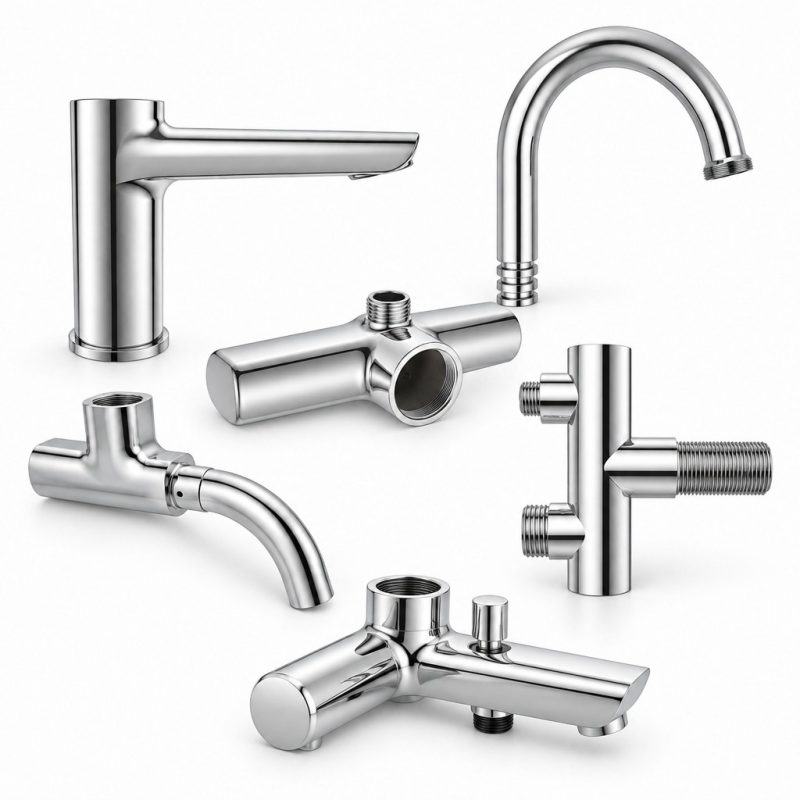
1. Engineering Challenges of One-Piece (Monobloc) Faucet Moulds
Unlike assembled multi-component taps, a one-piece faucet integrates the outer spout, mixing chamber, valve cartridge seat, and inlet threads into a single seamless body. This introduces three major tooling challenges:
- Complex Internal Fluid Cavities: The internal cold/hot water mixing passages require intersecting core-pulling mechanisms from multiple angles (XYZ axes) without creating flash or water leakage under hydrostatic pressure testing.
- Severe Parting Line Sensitivity: Curved faucet spouts and ergonomic handles are highly susceptible to visible parting line steps. For chrome plating, any step mismatch over 0.05 mm causes plating buildup, sharp burrs, or edge peeling.
- Wall-Thickness Transitions & Sink Marks: Thick structural bosses around thread inserts transition into thinner aesthetic shells, prone to sink marks, internal voids, and uneven thermal shrinkage.
2. Critical Tooling Solutions by HX Mould
A. Sub-Micron Parting Line Control (0.01 – 0.05 mm)
To achieve a seamless surface that eliminates manual hand-grinding, we utilize 5-axis Makino high-speed CNC milling (spindle speeds up to 30,000 RPM) and Sodick linear-motor mirror EDM. Core and cavity parting faces are precision matched to keep step differences strictly within 0.01 – 0.05 mm across complex 3D curved profiles.
B. Multi-Stage Hydraulic & Mechanical Core-Pulling
For integrated hollow spouts and cross-channel waterways, we engineer synchronized multi-stage hydraulic cylinders and angled slider lifters. Nitrided guiding tracks (HRC 58–62) ensure zero mechanical shifting during injection clamp pressures, maintaining 100% seal integrity on internal valve cartridge seats.
C. Conformal Cooling & Thermal Balance
By implementing optimized conformal cooling inserts around thick faucet base sections, cooling cycle times are shortened while eliminating sink marks and internal residual stress that cause electroplating blisters.
D. SPI A1 Mirror Polishing for Direct Chrome Plating
We use genuine imported S136 ESR (Electroslag Remelted) stainless mould steel vacuum-hardened to HRC 48–52. Cavities are diamond-polished to SPI A1 optical mirror finish. Molded electroplating-grade ABS parts go straight into chemical etching and chrome baths without manual buffing.
3. Monobloc Plastic Faucet Mould Tooling Matrix
| Tooling Parameter | HX Mould Engineering Standard | Conventional Market Standard |
|---|---|---|
| Parting Line Mismatch | 0.01 – 0.05 mm (No Flash) | 0.08 – 0.15 mm (Visible Flash) |
| Pre-Plating Polishing | Zero Polishing (Direct Plating) | Requires 100% Manual Buffing |
| Core & Cavity Steel | Assab S136 ESR / Daido NAK80 | 718H / P20 Standard Steel |
| Mould Tool Life | 500,000 to 1,000,000+ Shots | 300,000 – 500,000 Shots |
| Surface Optical Grade | SPI A1 / A2 Mirror Finish | SPI B1 / B2 Common Polish |
4. Step-by-Step Manufacturing Workflow at HX Mould
- DFM & Moldflow Simulation (Day 1–3): Comprehensive analysis of gate locations, weld line positions, gas traps, and shrinkage compensation.
- 3D Tool Design & Core Architecture (Day 4–7): Full 3D assembly design with multi-angle hydraulic slide kinematics and conformal cooling circuits.
- Precision CNC Machining & EDM (Day 8–20): Roughing, stress-relief heat treatment, high-speed 5-axis finishing, and mirror-finish linear EDM.
- Optical Mirror Polishing & Fitting (Day 21–25): Hand-lapping to SPI A1 optical standards and spotting press precision fitting.
- T1 Mould Trial & Quality Verification (Day 26–30): Trial injection using electroplating ABS, CMM 3D dimensional reports, hydrostatic testing, and sample dispatch.
Frequently Asked Questions (FAQ)
Q1: What plastic material is best for electroplated one-piece faucets?
Answer: Electroplating-grade ABS (such as Chi Mei PA-757 or LG ABS-727) is the industry benchmark due to its superior butadiene rubber phase distribution, which ensures strong chemical etching anchoring and high metal plating peel strength.
Q2: How does zero-polishing tooling save money in faucet production?
Answer: Manual polishing accounts for significant post-moulding processing costs. Furthermore, manual buffing risks rounding sharp design features and creating uneven wall thickness. With HX Mould’s 0.01–0.05 mm parting line accuracy and SPI A1 cavity finish, parts move directly to plating, cutting labor and scrap rates significantly.
Q3: Can HX Mould integrate brass threaded inserts in one-piece plastic moulds?
Answer: Yes. We engineer automated insert-moulding fixtures and robotic loading interfaces for brass inlet fittings (G1/2, G3/8, NPT) to guarantee torque resistance and zero joint leakage.
Start Your Custom Plastic Faucet Tooling Project
Looking to replace metal casting or upgrade your sanitary ware production lines? Contact Ningbo Hengxin Mold today for DFM evaluation and custom tooling quotation.